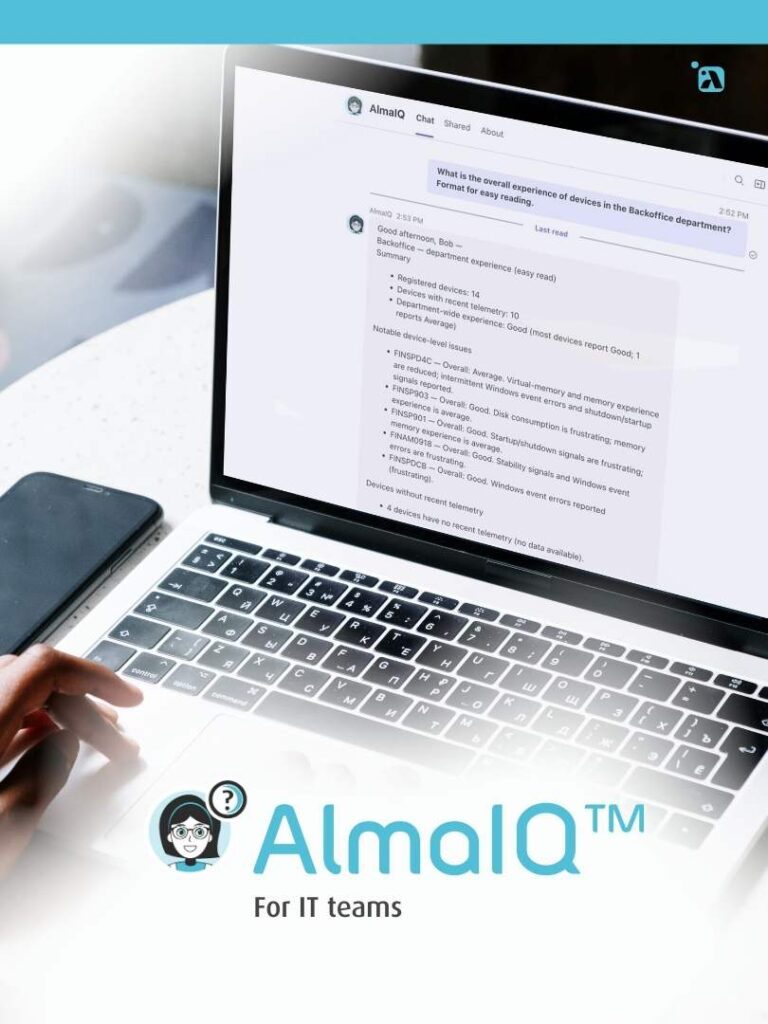
AlmaIQ™ brings unparalleled level of efficiency and effectiveness for IT teams using Collective IQ®
AlmaIQ™, the intelligent self-service agent for employees just received an incredible boost that expands its role to uniquely help IT teams. Interacting with users through Microsoft Teams, AlmaIQ™ answers questions about devices and internal processes in natural language. Whereas that intelligence simplified employees lives on the job, it now enables IT teams to interact with Collective IQ at the level of departments, groups, and collections of devices to spot patterns and trends. The overall result: vastly more productive operations and satisfied employees.
AlmaIQ™ is not your traditional chatbot
AlmaIQ™ is more than “just another chatbot” connected to a Help Desk. It is a purpose-built, generative AI agent specially created to avoid typical chatbot problems, such as limited intents and responses and complex maintenance that requires offline training.
A few points that set AlmaIQ™ apart:
- It supports natural language conversations inside Microsoft Teams, acting like a virtual coworker.
- It leverages Collective IQ data and analytics to address questions about employee digital experiences, device performance, and critical events.
- It makes use of corporate information stored in AlmaKnowledge™, such as policies, procedures, contacts, internal links, and more to effectively reply to employee and IT staff questions, always mindful of the individual’s role.
- When necessary, work-context responses are complemented with relevant information from the public internet.
- No personal or private information of any sort is kept or shared by AlmaIQ.
In contrast to legacy chatbots that depend on rigid flows and offline training, AlmaIQ™ takes advantage of generative AI capabilities to contextually converse, while providing responses and recommendations that utilize data collected and analyzed by Collective IQ and information that is routinely added to AlmaKnowledge™. Furthermore, the system is never taken offline to train models, create new intents, or update the knowledgebase.
How it works for IT staff and designated analysts
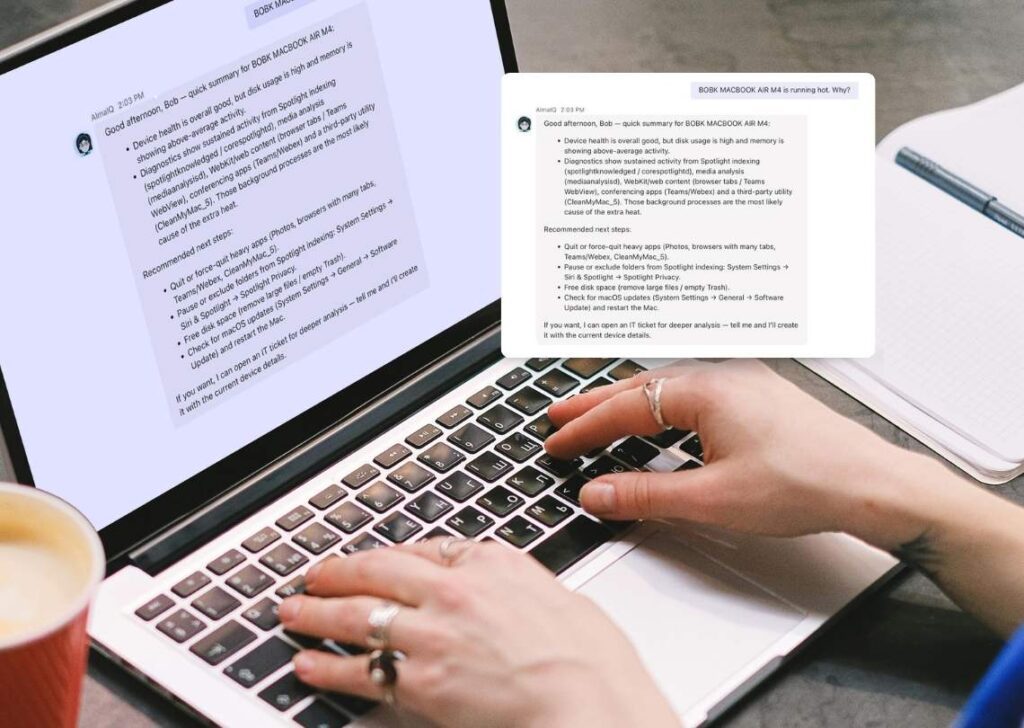
For enterprise employees, AlmaIQ™ already acts as a “digital concierge,” answering everything from “Why is my PC so slow?” to “Which hotel in Dallas does the Travel team recommend?”, and “Who can I speak with in HR that oversees my department?”. It can also take action, such as requesting an IT ticket to have more memory added to a PC.
For IT teams and designated analysts (e.g. a Finance member who is responsible for company inventory control), it is an evolved way to interact with Collective IQ. Imagine being able to ask questions in natural language, instead of navigating multiple graphs, screens, and drilldowns. Indeed, information can be concisely provided or elaborated and formatted for easy viewing. This yields faster, data-driven analyses and fact-based decisions.
Some sample use cases for IT staff and analysts:
“How are the devices performing for the Audit group?”
- Quick assessment of a team’s digital experience and bottlenecks.
“Leonardo’s desktop regularly shows poor performance, should it be upgraded or replaced?”
- Refresh and upgrade decisions based on actual usage, performance data, and real world costs and depreciation.
“Devices in the Finance Department are frequently having a bad experience. Why and what could we do about it?”
- Summarized view of previously undetected issues which may be common across devices, along with recommendations to resolve them.
“Windows PC QA807 runs poorly when many Chrome tabs are open. Can memory be added? If yes, create a ticket to add 16 GB of RAM.”
- Combine technical analysis and ITSM workflow automation in a simple, conversational manner.
Without having to specifically check the ticket system, “Which tickets have been opened for device DE650 and what is the status of each?”
- Save time finding information and distilling results.
In many cases, an analyst may reach similar conclusions by navigating the Collective IQ user interface, but it would take longer to review multiple charts and cross-reference data. Plus, such navigation would not take advantage of corporate knowledge or public recommendations based on trained insights. With AlmaIQ™, that journey becomes conversational, much more agile, and significantly more impactful.
Evolution of the user interface
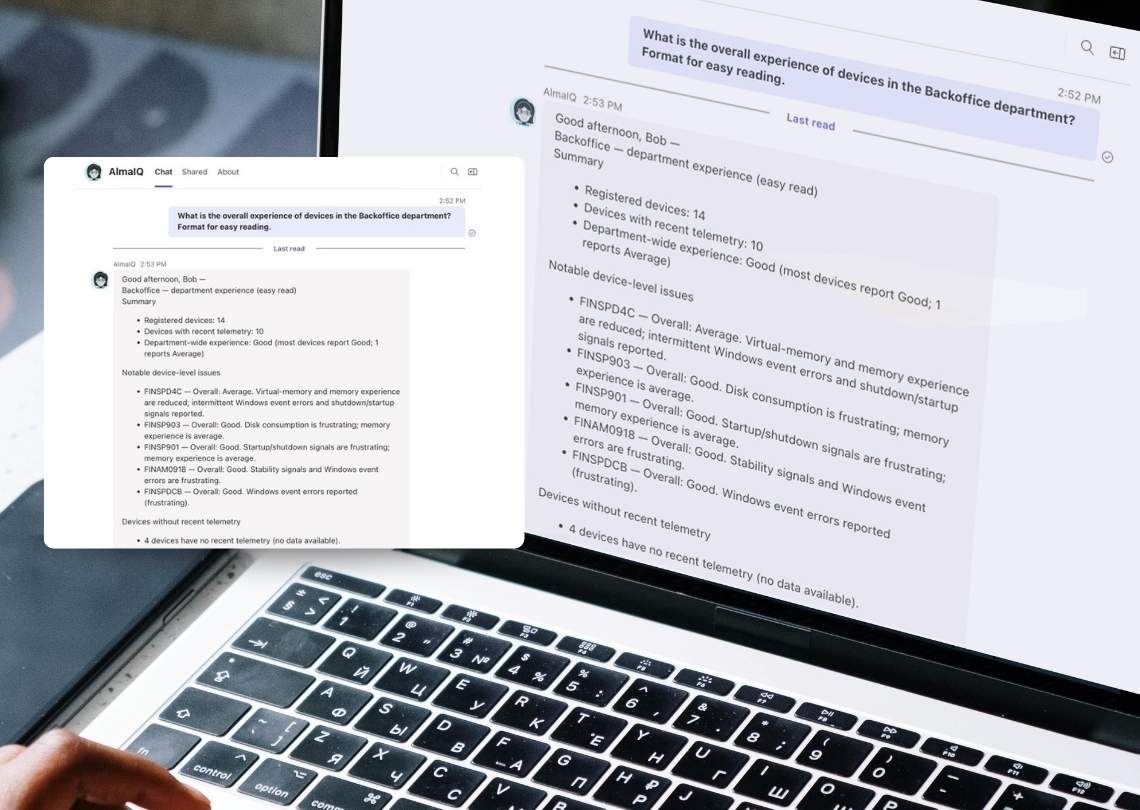
From a product perspective, AlmaIQ™ can be seen as a natural evolution of the Collective IQ interface. Instead of relying only on traditional dashboards, graphs, and drill-downs, the analyst gains a conversational channel that “brings” the right answers, at the right time.
This creates clear benefits for CIOs, IT managers, and operations leaders:
- More productivity: less time clicking through screens; more time acting on insights and recommendations.
- Better ROI from DEX: analysts make broader use across organizations of the rich data and insights generated by Collective IQ.
- Faster decisions and actions: evidence-based incident prioritization and hardware refresh planning.
- Less frustration: greater flexibility for IT and fast, useful answers for employees.
Integrations, roles, and working with other systems
Collective IQ is designed to complement IT tools already in use in the enterprise. For example, ITSM integration is already possible and straightforward (as demonstrated with Zendesk), enabling ticket creation and queries directly from AlmaIQ™. These tickets may include Collective IQ data, as well.
AlmaIQ™ is an effective way of surfacing Collective IQ data and enterprise information to employees, IT staff and analysts based on their role. Today, it interacts with employees and IT teams through Microsoft Teams®; in the near future, it will do the same via Google Chat .
Furthermore, AlmaKnowledge™ can take advantage of information provided by IT, HR, Finance, and other departments. Of particular note, the same AlmaIQ agent interacts with all enterprise employees, providing role-based information, thereby reducing system overhead. Even in environments that already use a chatbot, AlmaIQ™ can run in parallel as a “virtual coworker headquartered in Teams,” focused on digital employee experience, device data, and structured corporate knowledge.
What AlmaIQ™ is not
To be clear, AlmaIQ™ is not intended to replace general-purpose, generative AI tools like ChatGPT, Gemini, Perplexity, or similar.
It is not a:
- Tool for writing code, creating images, or generating business proposals.
- Generic internet search engine; it uses the web only when necessary to enrich a work-related answer.
However, AlmaIQ™ is an intelligent agent connected to Collective IQ®, specialized in digital employee experience as it pertains to devices, applications, collaboration software, and (via AlmaKnowledge™) internal company information. This is what makes it truly valuable for CIOs, IT leaders, and analysts.
Benefits for CIOs and IT leaders after a few months
What should a CIO expect from AlmaIQ™ after 3 to 6 months of combined use by employees and IT teams?
- Fewer support calls.
- Less time spent on repetitive analyses and support tasks.
- Higher return on DEX investments.
- A more responsive IT organization which is also more agile and business-aligned.
Conclusion
AlmaIQ™ for IT teams marks a new chapter in how organizations interact with Collective IQ®, turning complex analytics into accessible, conversational insights. By combining AI-driven assistance, device intelligence, and corporate knowledge in a single experience, it helps employees get answers instantly and empowers IT teams to act faster and more strategically.