The Future of Digital Experience in Companies: What Changes with DEX, AI, and the Employee at the Center
For decades, companies measured IT efficiency through technical indicators: servers up, systems online, equipment working. But does that actually mean a good experience for the people doing the work?
On the Future Vision podcast, hosted by Lucílio Macedo at the TV Serra Dourada studios, two specialists discussed the topic “The future of digital experience in companies.” The guests were Leandro Silva, Global CEO of Almaden, and Leandro Silvério, specialist in Strategic IT Governance and Digital Workplace at Positivo S+.
Below are the main insights from the conversation.

Too Much Technology or Too Much Complexity?
Lucílio Macedo opened the discussion by asking whether there is too much technology in organizations. Leandro Silva was direct:
“I wouldn’t say there is too much technology; I would say there is, in fact, too much complexity. For decades, IT departments have provided different tools, different portals, different platforms, but without ever paying attention to how that would affect users’ day-to-day work.”
The average user deals with dozens of portals, separate logins, and alerts from different systems. Today’s challenge is not having more or less technology, but making the technology already in place work better for those who use it.
The “Watermelon SLA” Concept and Digital Friction
Leandro Silvério introduced a concept: the “Watermelon SLA.” He explained:
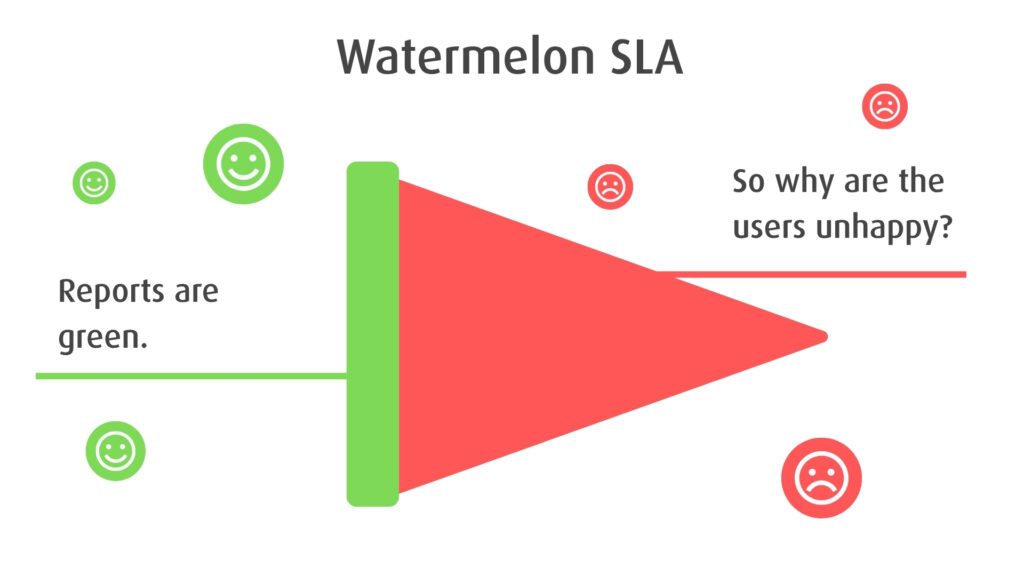
“The Watermelon SLA is a playful expression. In several dashboards, all performance indicators are green. But when you look at the actual results and go to the department to understand the experiences, you see the opposite reflection. It is red because many users see IT as a barrier to their performance.”
In other words, everything looks green in the reports. In practice, the employee’s daily routine is full of friction. Leandro Silva added:
“Today, if you ask IT managers how the environment is doing, 80% will say everything is green—the outside of the watermelon. If you ask the users, most of the time they have something to complain about. They are not producing as much as they could.”
This mismatch requires a cultural shift. Leandro Silvério said:
“You place the user at the center of attention in the technology world. All infrastructures and experiences revolve around the user, without setting security and compliance aside.”
The Small, Silent Problems That Affect Productivity
Lucílio asked about the digital friction that causes the greatest productivity loss. Leandro Silvério pointed to excessive security and the number of items that need to be checked before users can start working.
Leandro Silva added:
“These small problems do not happen once a month. They happen every day, many times a day. They wear employees down, make them less motivated, and cause what we call quiet quitting—the employee does not resign, but is no longer 100% engaged.”
He also warned about the impact on mental health:
“Imagine an employee who knows they can deliver more, but simply cannot because the technology provided is not performing well. That is frustrating. It makes talent look for other companies.”

DEX as Telemetry: Identifying Problems Before They Are Reported
Lucílio asked whether technology already exists that can identify employee problems before they even open a support ticket. Leandro Silvério replied:
“It does. In today’s market, this is called DEX—Digital Employee Experience. The tool works like telemetry within the corporate environment. We can observe small or large problems even before the user reports them.”
Leandro Silva explained that a DEX solution helps IT teams monitor and understand what happens on devices, but not only from a technical perspective; also from the experience perspective.
“How does a computer with little memory, limited disk space, and low CPU performance affect the experience of the person using it?”
With the use of artificial intelligence, DEX solutions can identify patterns:
“Could the problem affecting Leandro also be affecting João, Maria, or José? How many times does this problem repeat? What kind of fix can I apply for Leandro and repeat for the others, preventing them from going through the same situation?”
Balancing Security and Experience
Lucílio asked how to balance security without making the digital environment bureaucratic and tedious. Leandro Silvério replied:
“That is the million-dollar question. Security will never stop being critical. But there is a movement toward making user experience highly relevant in decision-making. It is a trend that is here to stay.”
Leandro Silva added:
“The information security discipline is much more mature than the DEX discipline. Now, many security solution providers are beginning to pay attention to experience—how that control will affect the person using it.”
Why Companies Spend Millions on Underused Tools
Lucílio noted that many companies invest heavily in technology, but some of the tools end up underused.
Leandro Silvério replied:
“What I observe is that this is closely related to operationalization. The team puts the tool into operation, but pays little attention to what it will run, whether it is user-friendly or not, and how productive that employee can be throughout the week. There are studies showing that around 40 to 50 minutes per week are lost by an employee due to performance issues. If we calculate that exponentially at the end of the year for a large department, we are talking about several million reais. So, if we put that calculation on the table, decisions over time will certainly move toward listening to the employee’s voice.”
Leandro Silva added:
“When a company is buying a new solution, it needs to think about what kind of problem or challenge that solution will solve. I’ll make an analogy: if I want to eat a steak, I do not want a Swiss army knife. I want a steak knife. To prevent the company from spending millions on technologies with many features that will remain underused, the ideal approach is to look at the three, four, or five use cases it has, and only then search for the solutions that best address those cases.”
AI: Replace or Empower?
Regarding artificial intelligence, Lucílio asked: did it come to replace people or empower them? Leandro Silva was emphatic:
“To empower people, processes, and tools, without a doubt.”
Leandro Silva emphasized that AI has already been a reality for decades, but it has become democratic in recent years:
“What will make the difference is how companies adopt AI. If adopted well, it tends to enhance results, decision-making, performance, and productivity.”
Regarding the impact on jobs, he said:
“I do not believe the number of jobs will decrease. As some jobs cease to exist, others will begin to emerge; roles that did not exist before will be created. Every change brings concern, but it also brings opportunity.”
Advice for Companies Getting Started
Lucílio asked for practical advice. Leandro Silvério replied:
“The first step is cultural. Listen more to the business areas. Satisfaction surveys are an excellent measurement tool to engage the technology department in adopting a DEX tool.”
Leandro Silva recommended:
“Start simple. Identify three or four points that can be improved through the adoption of a DEX solution. Keep scores from 0 to 10 or 0 to 5. Do not use 7.38 or 9.47. Track, take action, and observe the impact. Results come when you place the employee at the center.”
Conclusion
The future of digital experience in companies depends on less complexity, more balance, and the employee at the center. DEX, AI, and governance move forward together. IT that ignores digital friction will keep putting out fires. IT that measures and acts on the user’s real experience becomes strategic.
Want to apply DEX in your company?
Talk to people who work with this topic in practice. Discover Almaden Collective IQ®, which identifies patterns, reduces tickets, and improves digital experience without added complexity. Contact us, schedule a conversation or a personalized demo.