The 4 AlmaIQ™ Use Cases That Reduce Demand for Technical Support
Gartner predicts that, by 2029, active AI will be able to autonomously resolve 80% of common customer service issues, reducing operational costs by around 30%. This scenario reinforces the need to move from a reactive model to proactive strategies that prevent incidents from arising, especially Level 1 incidents, which account for a large share of service desk volume.
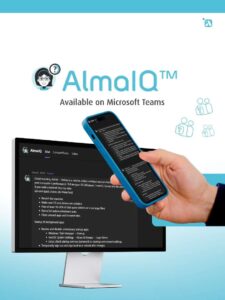
Within this context, AlmaIQ™ emerges as an intelligent concierge focused on IT operations, digital employee experience (DEX), and corporate productivity. Integrated into the Collective IQ® ecosystem, it uses contextual data from the environment to help employees and IT teams solve problems with greater autonomy and less dependence on support tickets.
In this article, we present four AlmaIQ™ use cases that help reduce demand for technical support without compromising governance, security, or the user experience.
1. Reducing repetitive tickets and first-level support
A large share of support’s operational volume consists of repetitive requests: slowness, intermittent failures, basic questions, and simple checks.
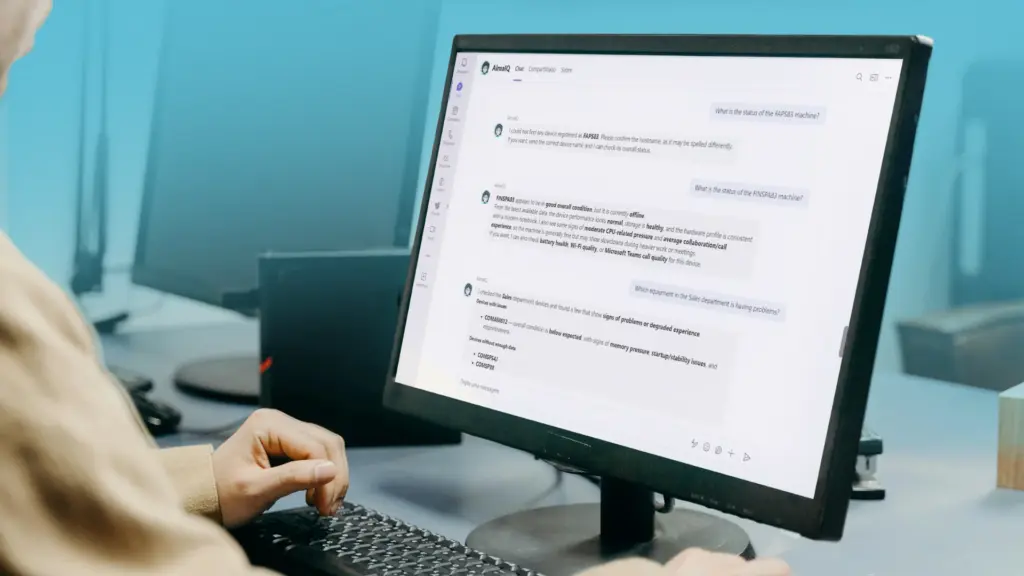
With AlmaIQ™, employees can consult the assistant directly from Microsoft Teams or Google Chat to understand possible causes related to the device, resource consumption, system stability, or application behavior.
Instead of opening a generic ticket such as “my computer is slow,” the user receives contextualized guidance based on data collected by the Collective IQ® DEX environment.
Example prompts:
- “Why is my laptop slow today?”
- “Is there any known issue with my device?”
- “Is my computer outside the expected standard?”
- “Has the system detected any recent problem?”
AlmaIQ™ guides employees on how to act when facing operational problems and questions, increasing their autonomy to resolve everyday situations without immediately depending on technical support. With fewer repetitive tickets, IT gains operational scale and more time for strategic initiatives.
2. Self-service for questions about applications, HR, and the corporate environment
Many internal tickets and requests are not related to technical failures, but to everyday operational questions: access to tools, internal processes, contacts in responsible departments, or understanding corporate policies.
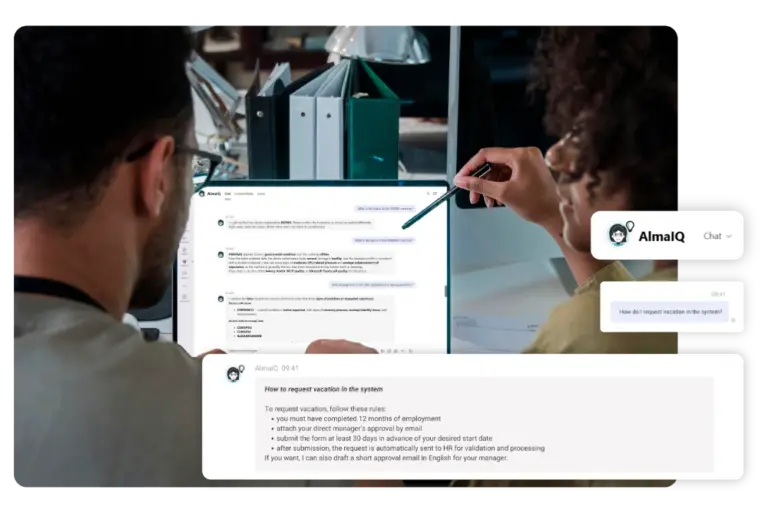
In addition to IT-related support, employees can also obtain answers related to HR, corporate processes, and guidance on responsible contacts when this information is available in the internal knowledge base integrated into Almaden’s environment.
Example prompts:
- “Who in HR supports my department?”
- “Who is the contact responsible for onboarding?”
- “Where can I find the hybrid work policy?”
- “How do I request vacation in the system?”
- “How do I open a request to replace my laptop?”
AlmaIQ™ can provide the correct contact based on available internal information and the employee’s organizational context, reducing the need to open tickets simply to locate information or responsible parties.
3. Identifying applications that impact the digital experience
Collective IQ® DEX makes it possible to analyze employees’ digital experience based on devices, applications, and operational behavior. AlmaIQ™ turns this data into simple, accessible interactions, translating technical metrics and signals into natural-language answers.
In practice, managers and analysts can quickly identify applications that degrade the experience or increase ticket volume.
Example prompts:
- “Which applications are generating the most problems?”
- “Is any software affecting user performance?”
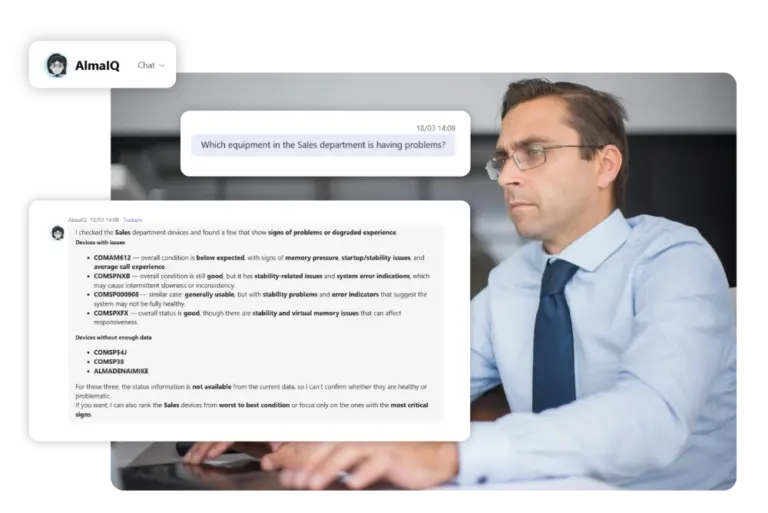
- “Which devices present the highest risk of incidents?”
- “Which applications have the worst digital experience?”
This type of analysis helps IT act preventively, reducing incidents before they become tickets.
4. Contextual support for IT and operations teams
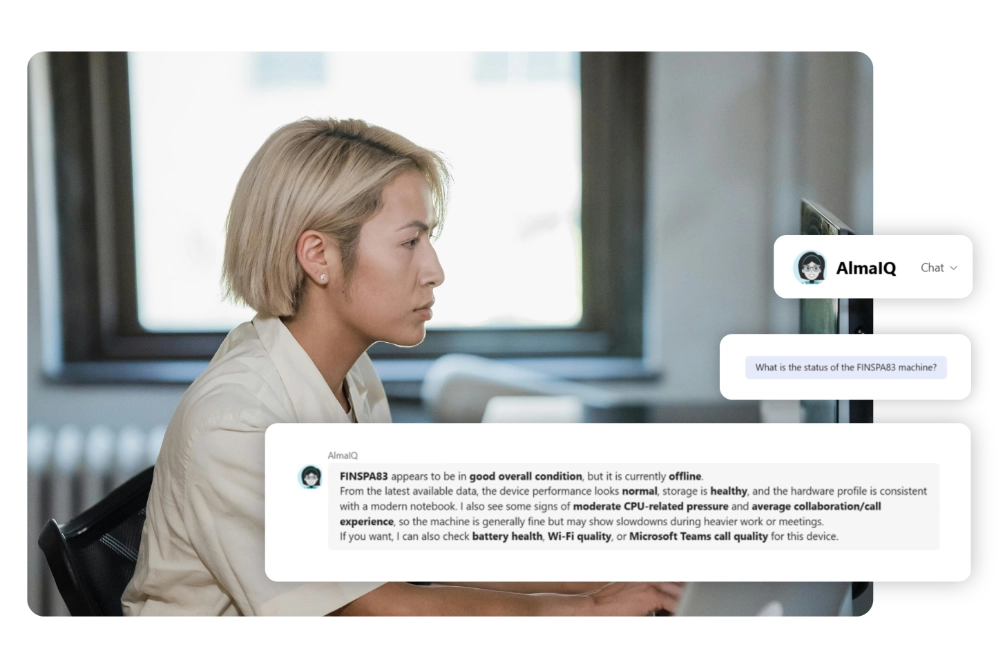
In addition to being used by employees, AlmaIQ™ also supports technical teams with contextualized access to operational information and environmental insights collected by Collective IQ®. This reduces the time spent on manual searches, data cross-checking, and repetitive analyses, allowing analysts and managers to focus on higher-impact decisions.
AlmaIQ™ can also generate executive summaries, comparisons between devices, and charts that make it easier to visualize trends and priorities.
Example prompts:
- “Is there an increase in incidents in any device group?”
- “Which machines have recurring failures?”
- “Is there a degradation trend in any application?”
- “Which users had the worst digital experience this week?”
With fast, contextualized answers, the team can accelerate investigations and prioritize actions more accurately.
The impact of AlmaIQ™ on IT operations
The adoption of conversational AI applied to the digital experience is not just about automation. The main benefit lies in reducing operational friction for employees and support teams.
By connecting digital experience data, device context, and natural language, AlmaIQ™ transforms technical information into actionable answers for employees and IT teams.
The result is a more proactive operation, with:
- Lower volume of simple tickets
- Reduced response time
- Greater autonomy for employees
- Better operational visibility
- Less repetitive effort for support teams
For CIOs and operations leaders seeking maturity in DEX and operational automation, AlmaIQ™ represents an important evolution in how IT delivers support and digital experience.
Implemented with proper governance and integrations, AlmaIQ™ is a strategic component for evolving from a reactive support model to a self-service and prevention ecosystem.
Discover how AlmaIQ™ transforms your IT. Talk to Almaden, learn about Collective IQ®, and schedule your personalized demo.