The Future of IT Is Conversational: Insights from CEO Leandro Silva at HDI Experience 2026
At HDI Experience, held September 16–18, 2026, Almaden’s CEO explained how AI and DEX are transforming enterprise support—and why the traditional service desk model has reached its limits.
The traditional support model can no longer keep pace with the complexity of modern IT. Leandro Silva, cofounder and CEO of Almaden, opened his presentation at HDI Experience with this straightforward observation.
“The traditional model can no longer keep pace with the complexity of modern IT. Things have changed.”
He outlined the factors that have made today’s landscape unsustainable for organizations still operating reactively: more devices, more applications, hybrid environments, greater impacts, longer queues, and more rework. He also highlighted the pressure coming from users:
“Users have higher expectations today. They want faster answers and simpler guidance.”
The conclusion is that IT needs to shift from reacting to anticipating. In Leandro’s words:
“IT needs to shift from reacting to anticipating.”
The Service Desk Shift: Conversation Before the Ticket
Leandro explained that this shift requires rethinking the support channel. Whereas users previously opened a ticket and waited, the conversation now needs to begin earlier:
“Today, the conversation has to start before a ticket is opened. Whether the conversation is initiated by the user or by IT, it comes before the ticket, with context, information, and data. That way, you accelerate resolution and have more satisfied, more productive end users.”
The Evolution of Interfaces: From CLI to Dashboards to Conversation
To put this shift into perspective, Leandro traced the evolution of user interfaces in technology products.
First came command-line interfaces, or CLIs: black screens, commands, and limited usability. Decades later came dashboards: colorful charts, click-based navigation, and data visualization. And now, the next stage:
“What is the trend today? This channel has to be conversational. IT teams need to be able to talk to their solutions. Ask practical, direct questions, as if they were talking to a colleague—and get data, recommendations, and information back.”
AlmaIQ™: AI That Speaks the Language of Employees and IT
Leandro introduced AlmaIQ™ as the solution that brings this vision to life. It is available within the Collective IQ® platforms (ITAM and DEX) and through integrations with Microsoft Teams or Google Chat.
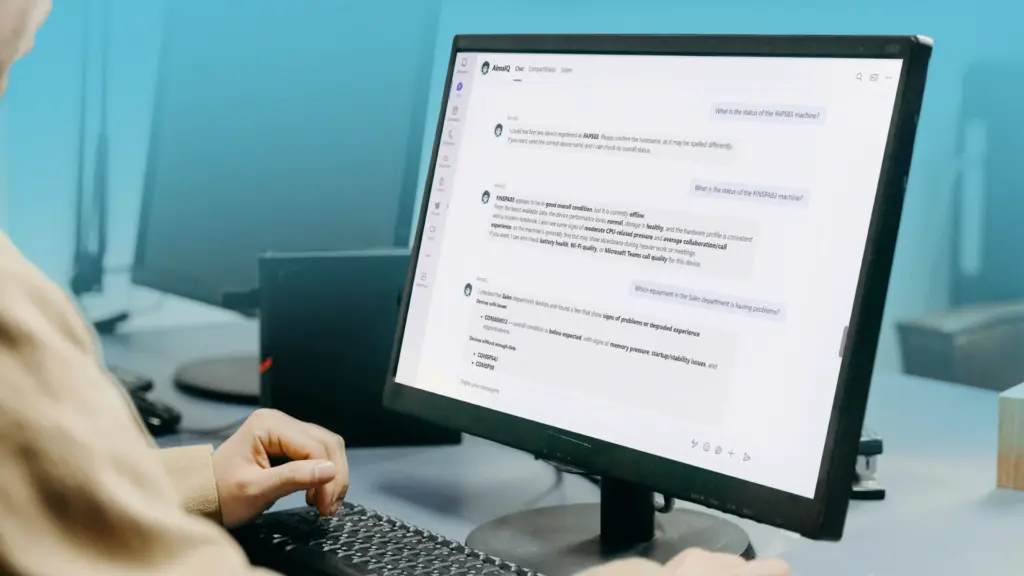
AlmaIQ™ provides conversational support, allowing employees to interact as if they were speaking with a colleague. It works with real context, not scripts: all data is collected directly by Collective IQ® in real time. Most importantly, it resolves issues before a ticket is opened. When a user reaches out, AlmaIQ™ not only diagnoses the issue based on data but also provides guidance and, whenever possible, resolves it through automation.
“AlmaIQ™ is not a chatbot. Despite appearances, it does not work like a traditional chatbot.”
AlmaIQ™ vs. Traditional Chatbots: The Differences
Leandro clearly explained why AlmaIQ™ is different from a conventional chatbot.
A traditional chatbot relies on predefined scripts and rigid workflows. If you do not phrase your question correctly, using the exact words it expects, it may be unable to respond. It has little context and depends heavily on how it was configured. Ultimately, it forwards the result to an ITSM or ticketing solution—in other words, the ticket goes to an analyst who may need to review everything from scratch.
AlmaIQ™, on the other hand, responds using real data. With every question, it checks the latest data before providing an answer. It uses natural language, so it understands analogies such as “my computer is moving at a snail’s pace.” It draws on context about devices, experience, department, work arrangements, and geolocation to deliver more accurate, personalized answers. And when it escalates an issue to an analyst, the ticket already includes context, a recommendation, and real data on what needs to be done.
“A chatbot would not understand the analogy ‘my computer is moving at a snail’s pace.’ Because AlmaIQ™ uses natural language, it understands that kind of analogy.”
In addition, whereas traditional chatbots are designed only for end users, AlmaIQ™ supports both users and technology teams, tailoring the level of detail in its responses to each audience.
Practical, Everyday Examples
Leandro demonstrated AlmaIQ™ during the presentation and shared examples of questions IT teams can ask.
An analyst can ask what the user experience was like on the finance director’s laptop over the past seven days and request a chart in the same question. They can compare data from different sources—for example, identify which computers experienced Microsoft Teams call issues over the past 15 days and correlate those issues with Wi-Fi problems on the same devices. They can ask which computers are consuming the most memory in the marketing department, or which computers still run Windows 10 and lack the resources needed to upgrade to Windows 11.
“With AlmaIQ™, you can simply ask: generate a report for me with this, this, and this. And it will deliver those reports, including tables and charts.”
AlmaIQ™ goes further: it provides not only the requested information but also recommendations and suggestions for further interactions.
The Role of DEX: Context for AI
Leandro emphasized that DEX (Digital Employee Experience) is what brings intelligence to the conversation.
“Without DEX, AI is just a chatbot. With DEX, AI begins to understand what is really happening and becomes much more valuable in the IT team’s day-to-day work.”
DEX provides the missing context: how resource consumption affects the user’s actual experience.
“A computer using 8 GB of memory may be a problem for one user, but not for another who has a more powerful device or runs applications that require fewer resources.”
The central idea is that, with AI and DEX working together, support shifts from reactive to predictive.
Business Benefits: Concrete Numbers
Leandro presented results measured among Almaden’s customers and partners.
Support requests can be reduced by up to 40%, thanks to the proactive detection of issues before users open tickets. Software spending can be cut by up to 30%, with license management identifying software that is installed but unused. Overall productivity increases range from 5% to 10%, as employees with a good digital experience face fewer interruptions and get more done. Hardware CAPEX can also be reduced by up to 20%, because IT knows exactly when and which devices need to be upgraded or replaced—and why.
“If Maria has a problem, José, Guilherme, and Fernando may well be experiencing the same issue. With Collective IQ®, you can move beyond individual analysis and analyze groups.”
Insights for the Future of IT
At the end of the presentation, Leandro left the audience with a thought-provoking question:
“I hope I have inspired you to ask yourselves: is our IT reactive, or is it already proactive?”
The presentation’s key insights point to an IT function that moves beyond asking what is happening and starts operating through data-driven conversations. The future of IT is conversational. The interface with technology shifts from dashboards to dialogue. The conversation comes before the ticket. AI without context is just a chatbot, and DEX is what makes AI useful for IT. Analysis moves beyond individuals to look at groups, revealing patterns and trends that isolated cases conceal. And the results are measurable: lower costs, higher productivity, and greater user satisfaction.
Want to learn how to apply this approach in your organization?
Contact the Almaden team and schedule a demonstration of Collective IQ® with AlmaIQ™.