
How to Communicate the Value of DEX and Gain Support Across the Entire Company
For a long time, talking about Digital Employee Experience (DEX) inside the company was almost synonymous with “making the computer faster” or “reducing support tickets.” Today, that view is limited. Digital Employee Experience is now treated as a direct lever for productivity, talent retention, and business results—not just as an operational IT concern.
The challenge is that, even with this growing relevance, many organizations still struggle to clearly explain why DEX matters and how to justify investments in this area. In other words, IT sees the problem, but it does not always manage to translate technical language into impact for areas such as the CFO, HR, Operations, or commercial leadership.
That is exactly where a structured communication approach makes a difference. When IT shows that DEX is not just a tool project, but a more strategic way to manage digital work, the conversation shifts to a higher level and begins to include revenue, efficiency, engagement, and employee experience.
Align DEX with Business Priorities
Before talking about metrics, dashboards, or artificial intelligence, it is essential to connect DEX to the agendas that are already critical to the company: growth, efficiency, customer satisfaction, and talent retention.
In practice, this means framing DEX around questions that truly matter to the board:
- How much productive time does the company lose when employees face daily friction with technology?
- How many sales, service interactions, or deliveries are affected by avoidable digital incidents?
- What is the cost of losing a talented employee because of a frustrating digital experience?
By bringing DEX into this type of discussion, IT stops talking only about tickets and SLAs and starts addressing EBITDA, talent retention, and the performance of strategic areas.
Explain DEX in a Simple Way

Instead of starting with architecture and complex indicators, a more effective way to communicate DEX is to define it as the way people experience the technology they use to work, from the first login to the last access of the day.
It is necessary to continuously measure and improve employees’ experience with devices, applications, and digital services, both in the office and in hybrid and remote models. When that experience is poor, the impacts show up in productivity, engagement, retention, and even the end customer’s experience.
Explaining DEX this way helps other areas understand that it is not a technological “extra,” but a management discipline that connects infrastructure, applications, and people.
Highlight the Visibility Problem
One of IT’s biggest challenges is not only resolving incidents, but also clearly seeing what is really happening to the end user. Without that visibility, IT acts reactively, responding to symptoms when the impact on productivity has already occurred.
In internal communication, this can be translated into messages that are closer to business reality, such as:
- “Today, we only discover that an entire team has a performance problem when productivity has already dropped.”
- “Without reliable data on digital experience, every technology decision becomes trial and error.”
By positioning DEX as the response to this visibility gap, IT creates a sense of urgency outside the technical area and shows why this topic should be shared with the rest of the organization.
Translate Technical Data into Business Impact

One of the most important recommendations is not to stop at the technical metric. It is not enough to say that latency went down or that an experience indicator improved; you need to explain what that means for operations and for the company’s results.
Some examples of more effective narratives:
- “By stabilizing the digital experience of the customer service team, we reduced customer wait time and avoided revenue loss during peak moments.”
- “By identifying bottlenecks in sales tools, we increased commercial productivity without expanding the team structure.”
- “By improving the digital experience in remote environments, we reduced employees’ daily frustration and supported talent retention.”
This translation from technical metrics to concrete impact is what turns DEX into a strategic priority, not just an operational topic.
Adapt the Message for Each Internal Audience
There is no single DEX message that works for the entire company. The message needs to be adjusted to what each area values.
- For Finance: highlight support costs, measurable productivity, and the relationship between digital experience and operational efficiency.
- For HR: emphasize the relationship between digital experience, engagement, retention, and employer branding.
- For Operations and business areas: focus on reducing interruptions, increasing delivery speed, and improving the quality of service for the end customer.
In this context, IT’s role is to act as a translator, using DEX data to build specific messages that make sense for each area’s goals.
Show That DEX Is a Continuous Journey

DEX has gone from being a buzzword to becoming a permanent pillar of IT and business strategy. This means it is not a one-time initiative, but a continuous cycle of measuring, analyzing, and improving the digital experience.
When communicating this internally, it is worth reinforcing two points:
- DEX requires governance, indicators, and constant reviews—just like information security or risk management.
- IT’s role evolves from a reactive area into a more strategic function, focused on performance, productivity, and support for business goals.
This positioning helps consolidate DEX as a management discipline and strengthens the case for consistent investments in technology, processes, and digital experience.
How Almaden Supports This Journey
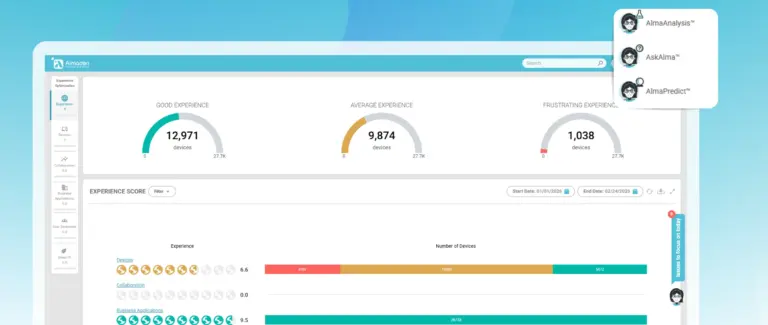
Collective IQ® is a platform that unifies ITAM and DEX with artificial intelligence, transforming asset and experience data into more proactive actions for IT. This approach helps teams move away from a reactive model and progress toward an operation with greater visibility, productivity, and decision-making capacity.
For organizations that want to communicate and prove the value of DEX more consistently, Collective IQ provides a concrete foundation for connecting digital experience, operational efficiency, and business results.
Discover how Almaden can help your company turn DEX into measurable value for both IT and the business. Schedule a demonstration of Collective IQ.